Skip to content

Applications

Payment Account (TPMA): A Modern Alternative to Client Accounts

Manage client money with full SRA compliance — while reducing admin work and operational risk for your team. An FCA-regulated alternative to traditional law firm client accounts.

FCA regulated
£18bn+ securely processed
Trusted by 40+ of the UK's top 100 law firms

Third-Party Managed Accounts

What is a TPMA?

A Third-Party Managed Account (TPMA) is a payment account provided by a regulated third party (like Shieldpay) to help law firms manage client funds — with the same safeguarding as traditional client accounts, and fewer operational burdens.

Shieldpay complies with SRA Accounts Rules and FCA safeguarding requirements (Payment Services Regulations 2017), giving you a compliant, efficient alternative to traditional client account management.

TPMAs offer the same safeguarding and control as traditional client accounts, with added operational benefits:

  • Regulatory burden shifts to the FCA-regulated provider
  • Automated reconciliation and reporting
  • No annual accountant reports required for TPMA funds (per SRA Accounts Rules guidance)
  • Enhanced fraud protection (Confirmation of Payee checks, ring-fencing)
  • Less admin work for your accounts team
  • Real-time visibility and audit trails

Important: Law firms using TPMAs remain subject to SRA regulatory requirements and oversight. While the compliance burden for fund safeguarding shifts to the FCA-regulated provider, AML responsibility remains with the law firm.

Why Shieldpay

Why Shieldpay

Our TPMA capability provides all the benefits of a traditional client account but with greater efficiency, automation, and security — allowing law firms to focus on legal work, not payment admin.

Control

Custom approval workflows, mirror ledgers and audit trails for each matter keep authority in your hands.

Clarity

Detailed views of every transaction with easy to use reports and statements across all matters.

Compliance

FCA regulated infrastructure, SRA compliant model and no need for annual accountant reports.

Confidence

Ring fenced accounts, CoP checks and strong cyber security reassure clients and protect reputation.

Traditional Client Account vs Shieldpay Payment Account

Both traditional client accounts and Shieldpay Payment Account safeguard client funds and maintain solicitor control. The difference lies in how we help you manage operational efficiency, reduce risk, and maintain compliance — with significantly less administrative burden.

What Matters Most Traditional Client Account Shieldpay Payment Account
Safeguarding & Control Full safeguarding, solicitor control Full safeguarding, solicitor control. FCA-regulated.
Annual Accountant Report Required (£3k–£10k+ cost) Not required for Shieldpay-held funds Less admin
Fraud Protection Standard bank security CoP checks, automated verification, real-time monitoring Enhanced
Reconciliation Manual, time-consuming Automated, real-time. Save up to 70% of accounts team time. Faster
Setup Time Weeks to months Days Faster
Visibility & Reporting Limited real-time access 24/7 portal access, custom reporting, audit trails Real-time

Key Takeaway: Shieldpay Payment Account provides the same level of protection and control as a traditional client account — with significantly reduced operational burden, enhanced fraud protection, and cost savings.

Ready to simplify client account management? Talk to our team to see how Shieldpay works for your firm.

Talk to us

Use cases

Built for real legal work

Conveyancing

We verify all payee details and hold completion funds until authorisation is provided.

Corporate

Manage deposits, escrows and deal proceeds with real-time visibility and faster reconciliation.

Litigation

Secure settlement and disburse funds quickly and securely with a full audit trail.

Private client

Manage trusts and estates with transparent reporting and hybrid flexibility.

Trusted by leading law firms

Shieldpay’s Payment Account demonstrates a commitment to innovation, security, professionalism and client care. Reassuring clients their funds are protected and in trusted hands.

image-png-3

ISO 27001

certified security


£18bn+

securely processed


Top 100

UK law firm adoption


How it works

Onboard and set up your Payment Account quickly in a few simple steps.

authorize-and-track-payments-image


Verify payments securely

Onboard quickly with integrated KYC and the right permissions for your team.

oversight-and-control-funds-image


Hold funds safely

Funds are ring fenced in FCA regulated accounts with Confirmation of Payee checks to reduce fraud.

SRA-rule-2.5-image


Disburse with confidence

Automated reconciliation, real time payments via Faster Payments and CHAPS and complete audit trails.

Compliance and security

• Safeguarding that aligns with SRA rules

• Ring fenced client funds

• ISO 27001 certified

• Permissions that reduce internal risk

• Mirror ledger per matter and a clear audit trail

• Fast and secure settlement of funds

• No annual accountant reports required

6f7376930e3761c732833d1873789adc1880e17d
REPORT

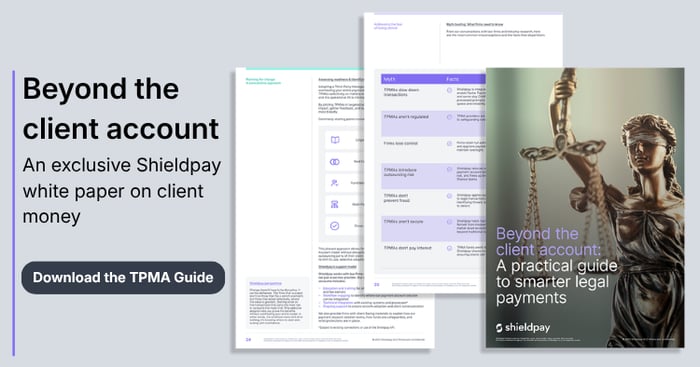
Beyond the Client Account: A Practical Guide to Smarter Legal Payments

A short guide on best practice for holding client money with a Third Party Managed Account. Clear steps, key checks and tips your team can use today.

Payment Account Whitepaper Image

Ready to take control without compromise?

Whether you’re curious about hybrid models, want to reduce operational overhead, or need to navigate regulatory change, we’re here to support you. Speak to a Shieldpay expert.

FAQ

Common questions about TPMA

Everything you need to know about compliance, operations, and switching to a Shieldpay Payment Account.

Yes. Shieldpay Payment Account (TPMA) complies with SRA Accounts Rules and FCA safeguarding requirements under the Payment Services Regulations 2017. Law firms using TPMAs remain subject to SRA oversight, but the regulatory burden for fund safeguarding shifts to the FCA-regulated provider.
No annual accountant report is required for funds held in your Shieldpay Payment Account (TPMA), per SRA Accounts Rules guidance. This significantly reduces cost and administrative burden for many law firms.
The law firm retains responsibility for AML compliance when using a TPMA. Shieldpay provides the verification infrastructure (KYC checks, sanctions screening, bank account validation) to support your compliance obligations, but AML responsibility remains with the law firm.
Both TPMAs and traditional client accounts safeguard client funds and maintain solicitor control. The key differences are operational: TPMAs offer automated reconciliation, enhanced fraud protection (Confirmation of Payee checks), no annual accountant report requirement, and the regulatory burden shifts to the FCA-regulated provider while you maintain full control.
Yes. Many law firms use Shieldpay Payment Account (TPMA) for conveyancing client money. Our Confirmation of Payee (CoP) fraud checks help prevent conveyancing fraud, which is a growing threat in UK property transactions.
TPMAs are used by law firms across all practice areas including conveyancing, general practice (litigation, family law, wills & probate), commercial law, and transaction-focused firms handling M&A and property deals. Any law firm managing client money can benefit from a TPMA.

Still have questions? Speak with one of our payments specialists — we're happy to walk you through how a TPMA works for your firm.

Speak to a payments expert