


Litigation Payments Distribution - How Payment Accounts TPMA's benefit every stakeholder
Litigation today is complex, collaborative, and financially intricate. Multiparty funding structures, conditional fee arrangements, cost sharing, group actions, international claimants, and the rising involvement of litigation funders have created a financial ecosystem where substantial sums move between multiple actors. In this environment, how those funds are collected, held, verified, and distributed isn't just back-office admin - it's a strategic priority.
A robust, transparent, and compliant payment distribution mechanism delivered through a Third-Party Managed Account (TPMA) offers a reliable solution for handling client money and paying every participant in the litigation supply chain efficiently, securely, and with reduced regulatory burden. This article explores how each professional group benefits when payment distribution is centralised, safeguarded, and digitised.
What is a Third-Party Managed Account (TPMA)?
A Third-Party Managed Account (TPMA) is an FCA-regulated account operated by a specialist payment provider, designed to hold, safeguard, and distribute funds in complex, multi-party transactions.
In a litigation context, a TPMA sits at the centre of the payment process, acting as neutral, regulated infrastructure between all parties. Rather than funds passing through any single participant's account, a TPMA provides a secure, independent mechanism that every stakeholder in the litigation ecosystem can rely on, from the point funds are received through to final distribution.
Why Modern Litigation Payment Infrastructure Matters
Traditional approaches to managing client funds, primarily through law firm client accounts, are being challenged by increasing regulatory sensitivity, cyber threats, and escalating operational costs. Litigation funders and insurers now demand greater transparency and reporting. These pressures highlight a critical need: a dedicated, regulated financial mechanism that can safeguard funds, reduce risk, and remove friction for everyone involved.
The right payment platform does more than move money. It transforms how you handle compliance, security, and client service.
How Modern Payment Distribution Works: Verify, Hold, Disburse
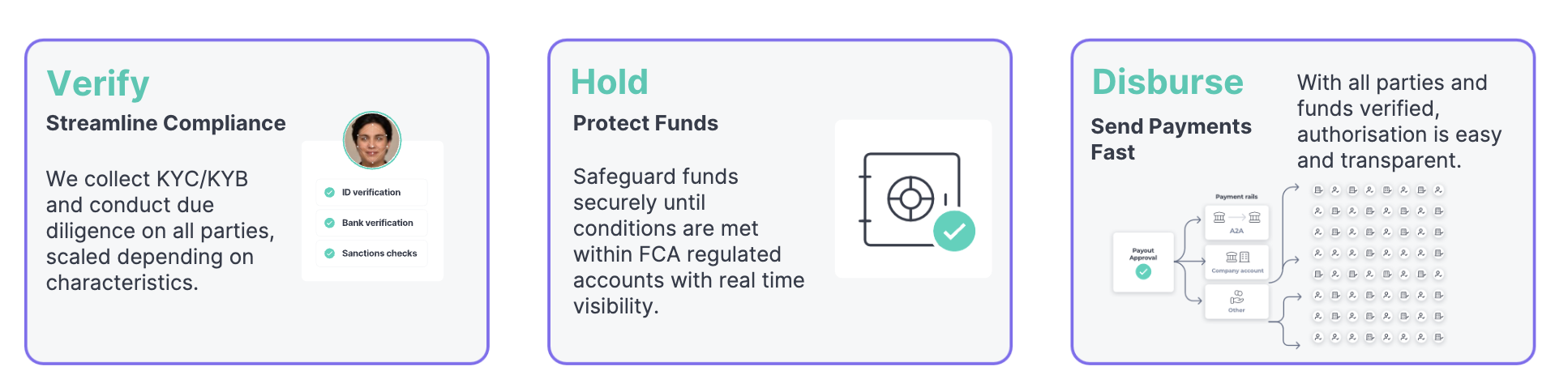
Modern payment distribution platforms operate across three core capabilities:
Verify | Solving the complexity of verification
Confirmation of Payee checks and sanction screens are conducted on all payees, delivering a smooth digital journey while preventing fraudulent or misdirected payments without the manual overhead of traditional verification. Robust processes for dealing with payment exceptions remove additional administrative burden.
Hold | Protecting funds until release
Funds are held in FCA-regulated, safeguarded, ringfenced accounts in accordance with PSR 2017 regulatory requirements, providing a compliant alternative to traditional law firm client accounts. Reconciliation is automated, giving all parties a clear, accurate view of fund status at all times. Funds can be held briefly to facilitate a straightforward transfer, or for longer periods where contingent payments or deal conditions apply.
The Safeguarding regime will be replaced by the FCA Client Assets (CASS) regime from 7 May 2026, and the new rules expressly address the receipt of unallocated funds (funds not allocated to a specific client) and unidentified funds (funds believed to be client money but requiring further investigation). If payment cannot be completed, regulated providers handle remaining funds in line with their Residual Balances Policy.
Disburse | Sending payments fast, wherever payees are
With parties verified and funds protected, payment authorisation is straightforward. Payments are sent directly into verified payees' bank accounts, at scale, domestically or internationally, with funds only released once agreed conditions and authorisation requirements are met, giving all parties confidence in the integrity of the process.
This integrated approach covers the full lifecycle of complex payments, introducing:
• Regulated protection using ringfenced, safeguarded accounts within FCA-authorised frameworks
• Operational efficiency through automated verification and claimant onboarding, reducing time and cost
• Enhanced security and fraud prevention strengthened through ISO 27001-accredited systems and advanced monitoring
• Systematic transparency giving parties clear visibility and auditability over incoming and outgoing payments
• Reduced professional indemnity risk particularly for law firms and experts handling large-value settlements
• Streamlined payment execution building trust with clients and transparency for all project stakeholders
This infrastructure supports complex litigation projects without the regulatory burden or operational strain of traditional client accounts.
Benefits Across the Litigation Settlement Supply Chain
Litigation Funders: Control, Confidence, and Clarity
Litigation funders inject capital but traditionally lack visibility into how funds flow once inside a law firm's client account. A robust payment platform eliminates that blind spot.
Key benefits:
Transparency over funds
Funders gain a clear, real-time view of how capital is being allocated across projects, something impossible through law firm-controlled accounts. Co-authorisation features allow funders to approve certain non-client-money disbursements such as returns to the law firm, repayment of the funding facility, or payments to third-party suppliers.
Risk mitigation
By centralising fund flows within a regulated environment, the risk of mismanagement, misuse, or dispute drops significantly.
Regulatory compliance
A dedicated payment mechanism supports funders' own reporting obligations and internal governance processes.
Accelerated returns
Automated claimant distribution speeds up settlement cycles, improving portfolio liquidity and faster recovery of capital.
Law Firms: Efficiency, Compliance, and Reduced Burden
Solicitors operating under the SRA Accounts Rules face increasing scrutiny. Managing large, complex payment flows, particularly in mass claims, is resource-intensive and carries regulatory risk.
Key benefits:
Protection through regulatory segregation
Funds held in safeguarded, FCA-regulated accounts satisfy strict requirements regarding separation of client money without needing the firm's own client account.
Operational efficiency
The burden of managing claimant onboarding, data collection, and payments transfers to the payment provider. This is particularly valuable in group actions where thousands of claimants require verification and disbursement.
Cost reduction
Running a client account is expensive. Audits, reconciliation, staff time, compensation fund contributions, and compliance overhead all add up. Many firms also see reduced professional indemnity premiums when using a TPMA.
Better customer experience
Volume projects receive dedicated support teams to manage queries, claimant communications, and verification workflows, improving satisfaction and reducing reputational risk.
Cybersecurity and fraud protection
Robust systems with ISO 27001 accreditation greatly reduce exposure to fraud attempts or cyber compromise.
Barristers & Chambers: Simplifying Compliance in a Restrictive Regime
Barristers face some of the strictest limitations on handling client money. Under Bar Standards Board (BSB) rules, barristers must avoid receipt of client funds except in narrow circumstances relating solely to legal services.
Key benefits:
Compliance assurance
A TPMA aligns with BSB guidance on using third-party payment services, enabling barristers to be involved in multi-party funding and settlement arrangements without breaching rules such as C74.2 and C74.3.
Clear multi-party fund management
Where fees, disbursements, or settlement monies need to be distributed across counsel teams, a payment platform provides a transparent, rule-compliant route.
Reduced administrative complexity
Chambers avoid the risks and burdens associated with receiving or distributing funds themselves, maintaining full focus on case preparation.
Expert Witness Firms: Professional Certainty and Reduced Credit Risk
Experts often experience delayed payments, unclear allocation of fees, and administrative friction, particularly in cases with multiple instructing parties.
Key benefits:
Reliable and timely payments
A payment distribution mechanism ensures experts are paid promptly once funds arrive, improving cashflow and reducing the need for credit control.
Clear fee allocation
Where costs are shared or staged, payment order lines can be allocated which confirms payments transparently.
Enhanced professionalism and trust
Knowing that funds are held securely and distributed impartially strengthens confidence between experts and the parties instructing them.
Cost Lawyers: Transparency in a Complex Payment Environment
Cost lawyers regularly handle significant settlement amounts or cost awards and must manage distributions precisely and compliantly.
Key benefits:
Transparent fund management
A clear, auditable mechanism for holding, verifying, and distributing sums received in costs proceedings.
Compliance and trust
Allows cost lawyers to act ethically and comply with client money handling rules while managing payments from litigants in person effectively.
Affordable client money solutions
Supports access to justice by enabling cost lawyers to handle litigant in person instructions compliantly without prohibitive costs.
A System That Works Better for Everyone
Across the entire litigation ecosystem, the benefits of adopting a robust, regulated payment distribution mechanism converge into three core outcomes:
1. Compliance
Every party benefits from outsourced regulatory protection, ringfenced safeguarding, and strict adherence to professional rules governing the handling of client money.
2. Transparency
All stakeholders gain visibility over fund flows, reducing the likelihood of dispute while increasing trust between law firms, funders, experts, counsel teams, and claimants.
3. Efficiency
Automated onboarding, verification, and payments reduce friction, speed up settlement, and free professional teams from significant administrative burdens.
Frequently Asked Questions
What are the benefits of a TPMA vs a traditional solicitor client account?
TPMAs remove annual audit requirements, reduce professional indemnity exposure, and offer automated reconciliation and dedicated claimant support; all while maintaining FCA-regulated fund protection.
How do TPMAs comply with SRA client account rules?
TPMAs operate under FCA authorisation and hold funds in ringfenced, safeguarded accounts that meet SRA client money protection requirements. The SRA explicitly permits firms to use regulated third-party payment services.
How are funds distributed in multi-claimant litigation?
Payment platforms verify each claimant's identity, allocate funds according to settlement terms, and disburse payments to verified accounts, managing all communication and verification workflows at scale.
Are there other payment vehicles beyond a TPMA for litigation?
Yes. Escrow arrangements suit transactions requiring funds to be held until specific conditions are met. Paying agent services coordinate verification and distribution in complex, multi-party corporate settlements. The right solution depends on transaction complexity and the number of parties involved.
How does litigation funding integrate with payment distribution?
Modern platforms provide real-time reporting on fund allocation, enable co-authorisation for non-client disbursements, and automate claimant payouts to speed up settlement cycles and capital recovery for funders.
What regulations govern litigation payments?
UK litigation payments are governed by SRA Accounts Rules, FCA Payment Services Regulations 2017, BSB Handbook, Money Laundering Regulations 2017, and Data Protection Act 2018 / UK GDPR.
How long does payment distribution take?
Modern platforms reduce distribution from weeks to days: claimant verification is often instant with exception processes for complex cases, domestic payments use real-time Faster Payments, and international payments take 2-5 business days depending on currency and jurisdiction.
Ready to Transform Your Litigation Settlement Payment Process?
Modern litigation demands modern payment infrastructure. Whether you're managing a multi-claimant group action, handling litigation funding arrangements, or distributing settlement proceeds across multiple parties, a robust TPMA reduces risk, cuts costs, and speeds up outcomes for everyone involved.
Shieldpay's TPMA Solution
Shieldpay has processed over £18 billion in complex transactions and distributed payments to thousands of claimants. Trusted by more than 40 of the UK's top 100 law firms, our platform is built on the Verify, Hold, Disburse framework:
• Verify: Automated Confirmation of Payee checks, sanction screening, and exception handling
• Hold: FCA-regulated, safeguarded accounts compliant with PSR 2017 (and ready for CASS 2026)
• Disburse: Real-time domestic payments and international reach via global payment rails
Our ISO 27001-accredited infrastructure handles high-value, high-volume litigation settlements securely and efficiently, with:
✓ Dedicated support teams for claimant queries and verification
✓ Automated reconciliation and real-time reporting
✓ Co-authorisation controls for litigation funders
✓ Residual Balances Policy for unallocated or unidentified funds
✓ API integration with case and practice management systems
Speak to our litigation payments team to explore how Shieldpay's TPMA can support your next settlement.

Conclusion: Payment Distribution Is Now a Strategic Differentiator
In a modern litigation landscape driven by funding, complexity, and scale, payment distribution is no longer a peripheral task. It's a central strategic function that drives compliance, builds trust, and protects the financial integrity of every party involved in a case.
-
For claimants, it means receiving compensation swiftly and securely.
-
For lawyers, it means lower risk and lower cost.
-
For funders, it means visibility and transparency.
-
For barristers, experts, and cost lawyers, it means certainty, clarity, and compliance.
A robust payment distribution mechanism isn't just a tool—it's infrastructure. And as litigation continues changing, those who adopt it will operate more securely, efficiently, and with full confidence in the integrity of their financial flows.

COMMENTS